More information: wiseqml.wordpress.com
WISE@QMUL presents Lost In Translation? The challenges of crossing borders
More information: wiseqml.wordpress.com
![]() |
| Picture from “Why women are under-represented in science and engineering“ |
Julia King describes five factors relating to confidence, stereotyped language (“scientists are ‘he’, hairdressers are ‘she'”), and a lack of role models that hold women back from careers in science and engineering in Guardian article, “Why women are under-represented in science and engineering“
![]() |
| JooHee Yoon’s illustration for NYTimes article, “Are Women Better Decision Makers?“ |
US Senator Kirsten Gillibrand argues for more women in Congress: “Women are more focused on finding common ground and collaborating.” Therese Huston describes another reason, beyond playing nicely, why we would benefit from having more women in power in NYTimes article, “Are Women Better Decision Makers?” reporting on studies showing women to have unique strengths in decision making under stress.
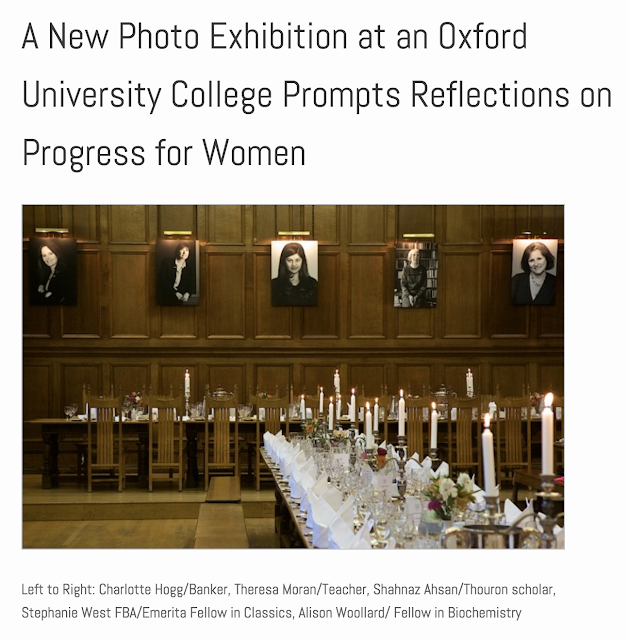
Photographer Robert Taylor was commissioned to install a portrait exhibition at Oxford’s Hertford College—www.hertford.ox.ac.uk/hertford-college-women-portrait-display—to celebrate the 40th anniversary of the first admission of women to the college. The portraits of the women replaces all those of men for a year. He reflects on the place and power of women, and the way we relate to their success, in British society today.
![]() |
| Illustration by Keetra Dean Dixon for NYTimes article “Learning to Love Criticism“ |
Tara Mohr reports in a New York Times article, “Learning to Love Criticism,” on studies showing that “powerful women tend to receive overreactive, shaming and inappropriately personal criticism”, and describes strategies for persevering in the face of criticism.
![]() |
| Royal Society University Fellowship Scheme: success rates of female applicants |
Statistics for the Royal Society University Fellowships Scheme show a sharp decrease in successful women over the years. President of the Royal Society, Paul Nurse, responds in a public statement: Gender balance among University Research Fellows.
Emma Watson, United Nations Women’s Global Goodwill Ambassador, delivers a speech urging men to join in the struggle for gender equality at a special event for the HeForShe campaign at the United Nations Headquarters in New York, 20 Sep 2014.
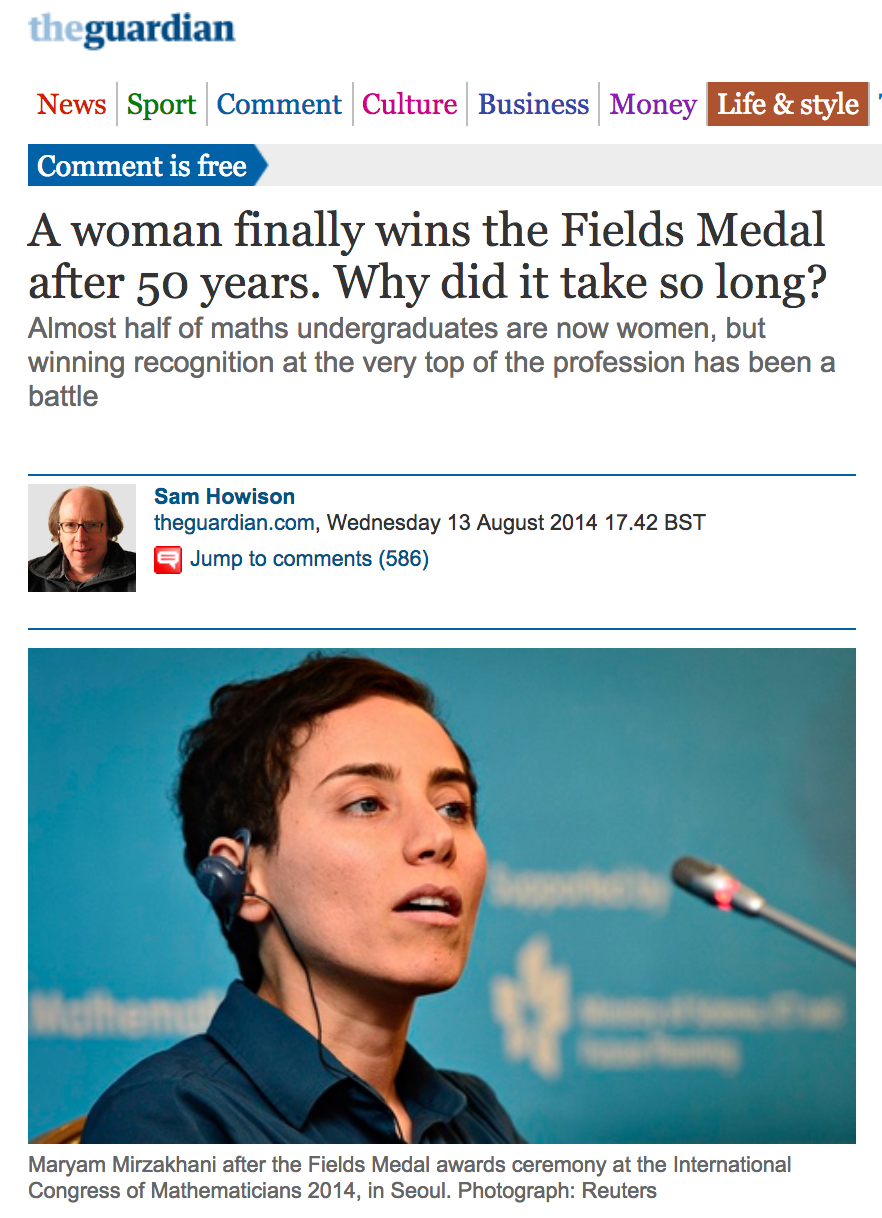
Women make up almost half of mathematics undergraduates, but winning the highest accolade of the profession, the Fields Medal, has proved to be a battle. Sam Howison of the Guardian discusses the reasons in the article: “A woman finally wins the Fields Medal after 50 years. Why did it take so long?“
Maryam Mirzhakani, Professor at Stanford University, is the first woman to win the Fields Medal, the highest honour accorded a mathematician, in the history of the award.
Some quotes from Ian Sample’s article in the Guardian, “Fields Medal mathematics prize won by woman for first time in its history“:
“Although women have contributed to mathematics at the highest level for a long time, this fact has not been visible to the general public. I hope that the existence of a female Fields medallist, who will surely be the first of many, will put to bed many myths about women and mathematics, and encourage more young women to think of mathematical research as a possible career.”
~ Sir Tim Gowers, Cambridge University
“The social barriers for girls who are interested in mathematical sciences might not be lower now than they were when I grew up. And balancing career and family remains a big challenge. It makes most women face difficult decisions which usually compromise their work”
~ Maryam Mirzhakani, Stanford University
“Maths is a hugely rewarding subject, but sadly many children lose confidence very early and never reap those rewards. It has traditionally been regarded as a male preserve, though women are known to have contributed to its development for centuries – more than 16 centuries if we go back to Hypatia of Alexandria.
In recent years around 40% of UK undergraduates studying maths have been women, but that proportion declines very rapidly when we look at the numbers progressing to PhDs and beyond. I hope that this award will inspire lots more girls and young women, in this country and around the world, to believe in their own abilities and aim to be the Fields medallists of the future.”~ Frances Kirwan, Oxford University
Read more at www.theguardian.com/science/2014/aug/13/fields-medal-mathematics-prize-woman-maryam-mirzakhani
Outline:
1. Being mistaken for the secretary
2. Being mistaken for the tea lady
3. Being called a “good girl”
4. Being accused of menstruation when voicing a firm opinion
5. Being asked if ‘a man is available instead’
6. Having an idea ignored only to be repeated by a male colleague five minutes later to interest and applause
7. Being asked about childcare plans
8. Being considered a ‘maternity risk’
9. Being accused of ‘baby brain’
10. Avoiding wandering hands